Why Reduce PDF File Size?
Oversized PDF files cause failed email deliveries, rejected job portal submissions, slow mobile downloads, and wasted cloud storage. Reducing document size ensures your files transmit smoothly across all platforms.
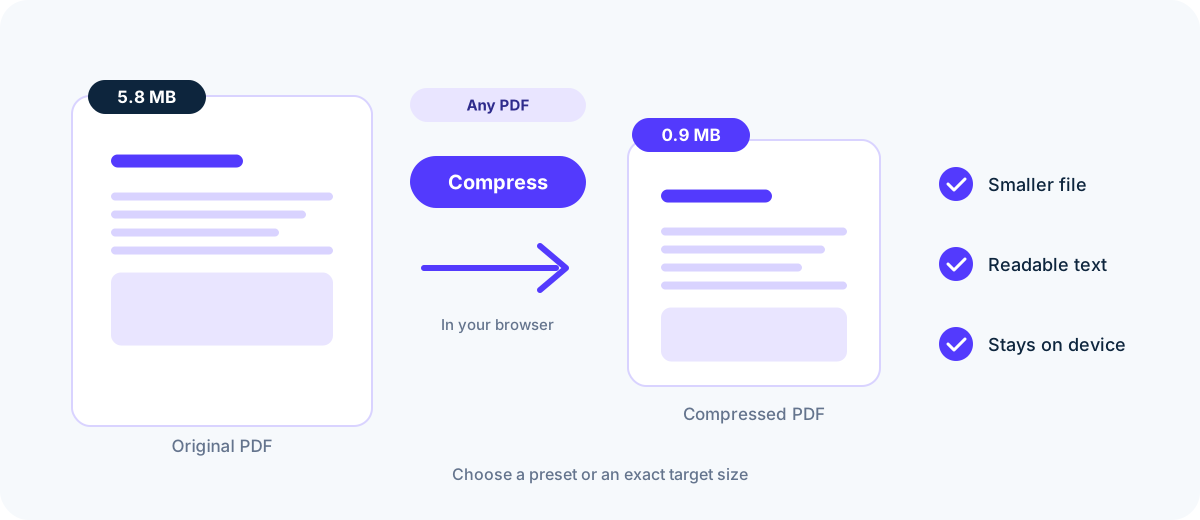
Summary: Reducing a PDF's file size means re-encoding its images, not deleting pages. This is the approach Kompres PDF takes: it recompresses embedded images and strips redundant metadata locally in your browser, so image-heavy scans shrink by 50–80% while text stays sharp. Compare the original and compressed size before downloading; the file is never uploaded. According to the PDF 32000-1:2008 specification, image and font streams dominate a document's byte weight, which explains why scans respond best to compression.
Your files are never uploaded to our servers — all compression happens right inside your browser
or pick multiple files at once from your device
Choose PDF filesOversized PDF files cause failed email deliveries, rejected job portal submissions, slow mobile downloads, and wasted cloud storage. Reducing document size ensures your files transmit smoothly across all platforms.
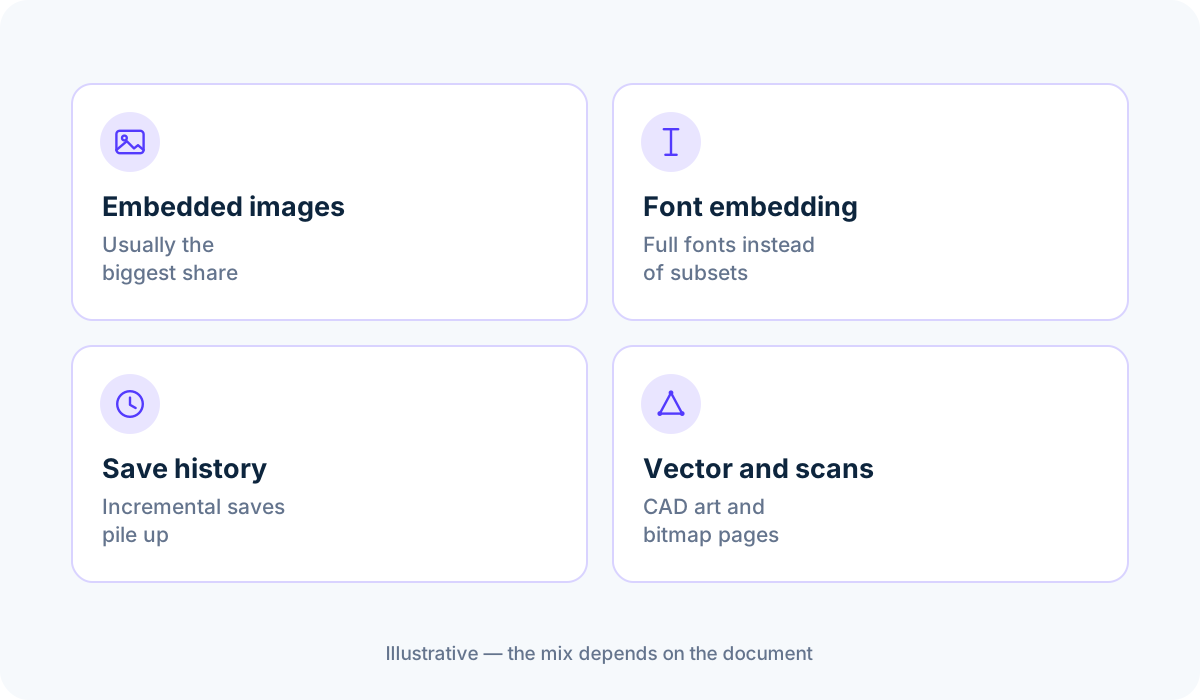
Every PDF is composed differently. Scanned pages and high-resolution photo portfolios reduce by 50% to 80%, while pure text documents created from Microsoft Word or LaTeX are already compact and have less compressible image overhead. According to the PDF 32000-1:2008 specification [1], scanned pages are stored as full-page raster images, which is why they carry far more compressible data than text documents. The PDF compression guide explains each mechanism behind these numbers.
Our engine optimizes embedded images and removes redundant metadata. If a vector document cannot be made smaller without quality degradation, the tool preserves the original file so you never get an unexpectedly bloated result. According to the WebAssembly specification [3], the optimizer runs in a sandboxed virtual machine, and according to MDN's File API documentation [2], the file is parsed locally before optimization begins.
Once compressed, review the exact original size, compressed size, and percentage saved before downloading. Re-run with different presets for greater reduction.
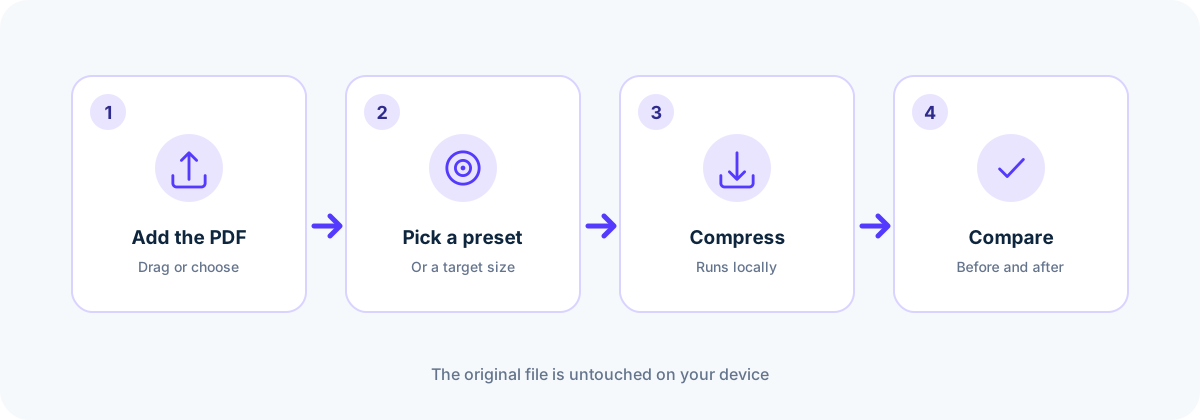
Simply drag your PDF into the upload area above, select a preset, click Compress Now, and download your smaller document directly from your browser.
PDFs that consist purely of plain vector text and standard system fonts are already very small. Image-heavy PDFs, scanned documents, and design mockups yield the highest reduction percentages.
No. With our High Quality and Balanced presets, typography remains sharp and legible for screen reading and standard office printing.
Standards, official documentation, and technical references behind the guidance on this page.